A buyer calls about a plot on Monday. Your agent says, "I will send you the details." By Thursday nobody has called back, and the buyer has already visited another office. Sound familiar?
Most real estate offices do not have a lead problem. They have a follow-up problem. Inquiries arrive from property portals, Facebook, WhatsApp, phone calls and walk-ins, and then they live in a diary, a chat thread or one agent's memory. When the office gets busy, the follow-up is the first thing to slip.
This guide explains why property leads go cold and shares a simple follow-up system that any small office can start using this week, with or without software.
Why property leads go cold
1. Leads are scattered. One inquiry is in a WhatsApp chat, another is on a sticky note, a third is in a portal inbox that only one person checks. If you cannot see all your leads in one place, you cannot follow them up properly.
2. Nobody owns the lead. When a call comes in, whoever picks up the phone talks to the buyer. Later, each person assumes someone else will call back. A lead without a named owner is a lead that waits.
3. There is no next date. "I will call you soon" is not a plan. Without a fixed follow-up date, the lead only gets attention when the buyer chases you, and serious buyers rarely chase for long.
4. Notes are missing. The buyer said they want a corner plot, a budget within a certain range, and a home near a school. If that is not written down, the next conversation starts from zero, and the buyer feels they are not being heard.
5. The owner cannot see what is happening. Without a simple view of all open leads, the owner only learns about lost deals when it is too late.
A simple follow-up system that works
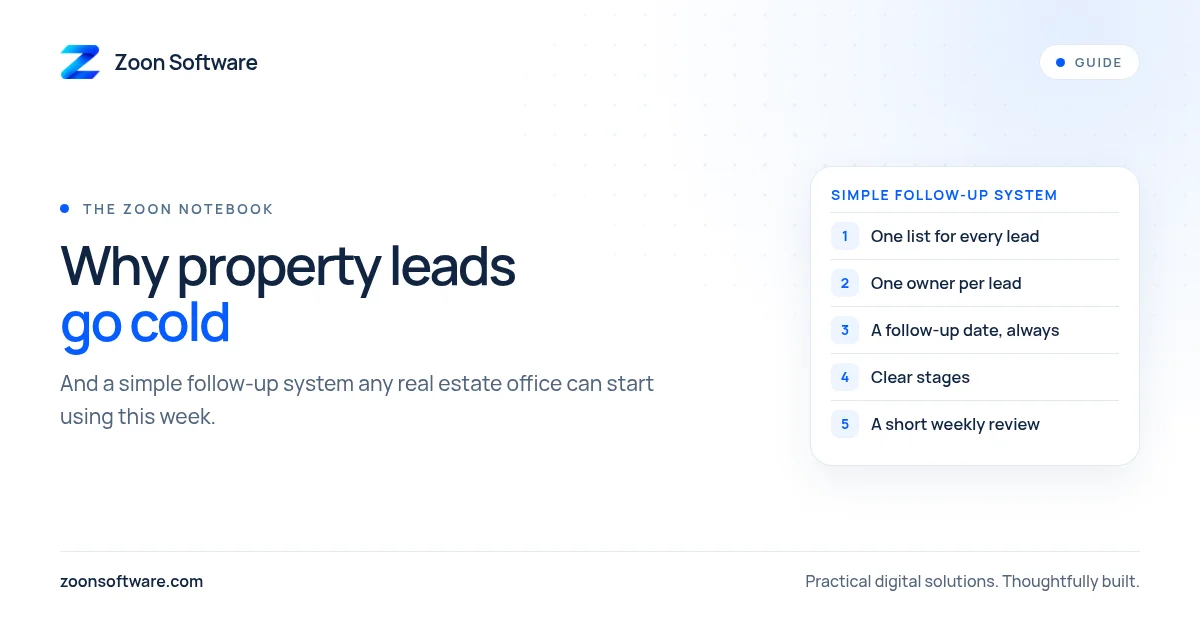
You do not need anything complicated. A good follow-up system has five parts.
1. One list for every lead
Every inquiry goes into one list, whatever the source. For each lead, record:
- Name and phone number
- What they asked about (property, area, budget)
- Where the lead came from (portal, Facebook, walk-in, referral)
- The agent responsible
- The next follow-up date
- Short notes from each conversation
At first, this can be a shared register or a simple sheet. What matters is that there is only one list, and everyone uses it.
2. One owner for each lead
As soon as a lead is added, assign it to one agent. That agent is responsible until the lead is closed or clearly lost. If the agent is on leave, the lead is handed over on purpose, not left in the air.
3. A follow-up date, always
No lead should ever be in the list without a next date. After every call or visit, the agent writes down what was discussed and when the next contact will happen. Then, each morning, the team looks at one question: whose follow-up is due today?
4. Clear stages
Give each lead a simple stage so everyone knows where it stands. For example:
- New: just arrived, not yet contacted
- Contacted: first conversation done
- Visit planned: site visit booked
- Negotiating: price and terms being discussed
- Closed: deal done, or the buyer has decided not to go ahead
Moving a lead from one stage to the next makes progress visible, and it shows quickly where leads get stuck.
5. A short weekly review
Once a week, the owner and agents spend a few minutes on the list. Which leads have no date? Which have been sitting in the same stage for too long? Which sources bring buyers who actually visit? This short habit keeps the system alive.
Small habits that make a big difference
- Reply quickly. Even a short message like "Thank you, I will share the details by this evening" tells the buyer you are serious.
- Send what you promised. If you said you would share photos, a location pin or a price sheet, send it the same day.
- Use the buyer's own words in your notes. It makes the next call feel personal.
- Close the loop. If a buyer is no longer interested, mark it and note the reason. Over time, those reasons tell you a lot about your listings and pricing.
- Keep your listings accurate. Nothing cools a lead faster than "sorry, that one is already sold."
When a notebook or spreadsheet is no longer enough
A paper register or a shared sheet is a fine place to start. But as the number of agents and listings grows, problems appear: two people edit the same file, dates are missed because nobody gets a reminder, and the owner has to ask everyone for updates.
This is where a simple inquiry system helps. Inquiries from your website can arrive automatically, staff can add calls and walk-ins, each lead has an assigned agent and a follow-up date, and a dashboard shows what is due today. The owner can see which sources and agents are bringing real buyers without asking around.
If you would like to see what this looks like, try our EstateZoon demo at estatezoon.zoonsoftware.com. It is a demo with sample data, built to show a real estate office how listings, an inquiry pipeline and a dealer dashboard can work together. You can also read more on our work page.
Start this week
You can start today with nothing more than a register: one list, one owner per lead, a date for every follow-up, and a weekly review. Once that habit is in place, software simply makes it easier.
If you want a system built around how your office already works, we are happy to talk it through. Email us at contact@zoonsoftware.com or reach us through our contact page. No pressure, just a practical conversation about what would help your team.