If you run a clinic, a shop, a property office or a coaching centre, someone has probably told you that you "need an app". Maybe a customer asked if you have one. Maybe a competitor just launched one. Before you spend money, it helps to step back and ask a simpler question: what do your customers actually need to do, and where will they do it?
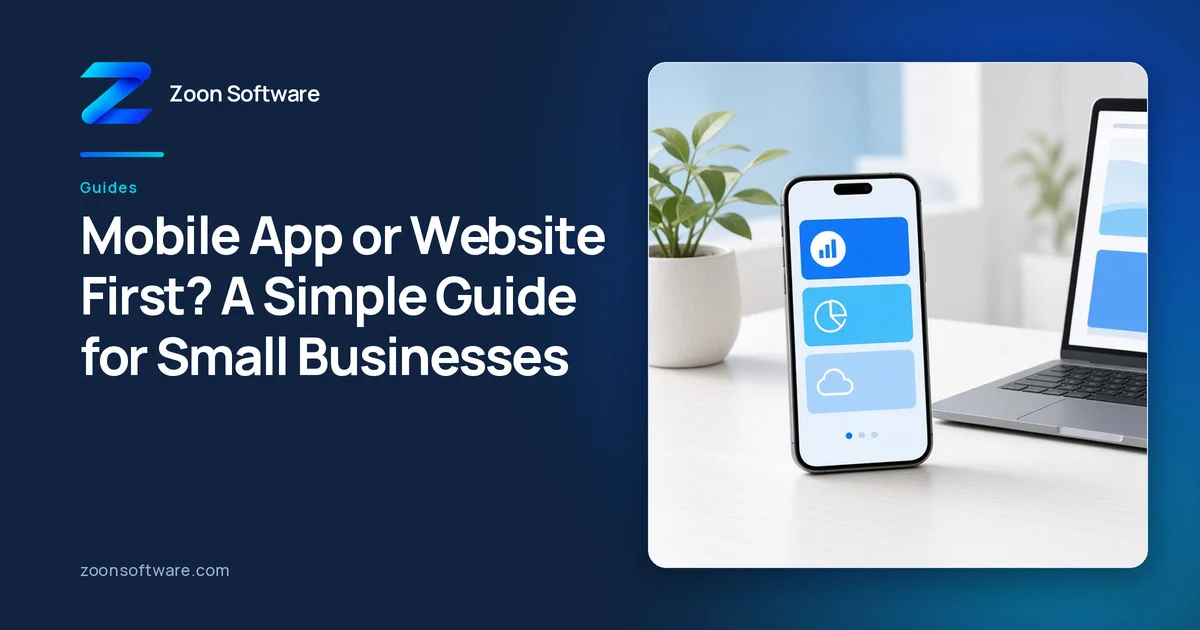
For many small businesses in Pakistan, the answer is a good mobile-friendly website first. For some, a mobile app is the right next step. This guide explains the difference in plain language and gives you a short checklist to decide.
Start with what your customers need to do
Forget the technology for a moment. Write down the three or four things a customer most often wants from you.
A clinic patient may want your timings, your location and a way to book a visit. A property buyer may want to see listings and send an inquiry. A parent at a coaching centre may want to check the timetable, fees and their child's results. A shop customer may want to see what you sell and place an order on WhatsApp.
Now ask two questions about each task:
- How often does the same person do it? Once in a while, or every week?
- Do they need to find you first, or do they already know you?
These two answers do most of the deciding for you.
What a website does well
A website is the front door of your business on the internet. Anyone can open it from a link, a Google search or a QR code, on any phone or computer, without installing anything.
A website is usually the better first step when:
- People need to find you. New customers search on Google for things like "clinic near me" or "plots for sale in my area". A website can appear in those results. An app on its own does not bring new people to you.
- Visits are occasional. Most people will not download an app to check your timings once or send one inquiry.
- You want to share information quickly. Services, prices you choose to show, location, photos, listings and contact details are easy to keep up to date on a website.
- You want inquiries and bookings. A clear inquiry form or simple booking page can work well on a mobile-friendly website.
If you are still deciding between a Facebook page and a website, our guide on Website vs Facebook Page explains what each one does.
What a mobile app does well
A mobile app lives on a person's phone after they install it. That extra step is the main difference. People only install an app when they expect to use it again and again.
A mobile app can make sense when:
- The same people use it often. For example, parents checking attendance and results every week, regular customers reordering from your shop, or your own staff recording work in the field.
- Notifications matter. An app can send reminders and updates straight to the phone, such as a fee reminder, an appointment reminder or an order status.
- It is used by your own team. Field agents, delivery staff or teachers may need a simple tool on their phones to update records during the day.
- Phone features are part of the job. Some tasks work better with the camera, location or offline access that an app can use more easily.
In short, a website helps people find you and contact you. An app helps people who already know you do something regularly.
The questions to ask before you decide
Use this checklist with your team. Answer honestly.
- Do most of our customers find us for the first time online? If yes, start with a website.
- Will the same customer use this every week or more? If not, an app will likely sit unused.
- Do we need to send reminders or updates to the phone? If yes, an app may help, though WhatsApp or SMS may be enough at the start.
- Is this mainly for our own staff? An internal app or a simple web-based system can both work. The choice depends on how and where staff work.
- Who will keep the content and data up to date? Any website or app needs someone responsible for it.
- What is the one problem we most want to solve first? Pick one. You can add more later.
If most of your answers point to "finding us" and "occasional use", a website is the right first step. If they point to "regular use", "reminders" and "people who already know us", an app may be worth discussing.
You do not always have to choose one
Many businesses start with a website and add an app later, once they see real, repeated use. Others start with a web-based system for staff, and later add a mobile app for customers who come back often.
It also helps to plan the data behind both. If your website, your app and your office records all use the same information, you avoid typing things twice and keep everyone in sync. If you are weighing a ready-made tool against something built for your business, our guide on Custom Software vs Off-the-Shelf Apps may help.
Common mistakes to avoid
- Building an app because a competitor has one. Start from your customers' needs, not someone else's choice.
- Launching without a plan to get people to install it. An app no one downloads cannot help you.
- Ignoring the mobile view of your website. Most visitors in Pakistan will open your site on a phone. If it is slow or hard to read on a small screen, fix that first.
- Trying to do everything in the first version. A focused first version that solves one clear problem is easier to launch, learn from and improve.
- Forgetting support after launch. Websites and apps both need updates and care over time.
A simple way to move forward
- List the tasks your customers and staff do most often.
- Mark each one as "finding us", "occasional" or "regular".
- Choose the one problem that matters most right now.
- Decide whether a website, an app or a web-based system solves that problem best.
- Start with a focused first version, then improve it based on real use.
Not sure which one your business needs?
Every business is different, and the right answer depends on your customers, your team and the problem you want to solve. At Zoon Software, we build websites, custom business software and mobile apps, and we start every project by understanding the problem before suggesting a solution.
If you would like a second opinion on whether a website, an app or both makes sense for your business, tell us what you are working on. Email us at contact@zoonsoftware.com or use the Discuss Your Project form on our website. We will help you find a practical way forward.